
Overview


Prerequisites
Prerequisites
- BTP Account
Set up your SAP Business Technology Platform (BTP) account.
Create a BTP Account - For SAP Developers or Employees
Internal SAP stakeholders should refer to the following documentation:
How to create BTP Account For Internal SAP Employee, SAP AI Core Internal Documentation - For External Developers, Customers, or Partners
Follow this tutorial to set up your environment and entitlements:
External Developer Setup Tutorial, SAP AI Core External Documentation - Create BTP Instance and Service Key for SAP AI Core
Follow the steps to create an instance and generate a service key for SAP AI Core: Create Service Key and Instance - AI Core Setup Guide
Step-by-step guide to set up and get started with SAP AI Core:
AI Core Setup Tutorial - An Extended SAP AI Core service plan is required, as the Generative AI Hub is not available in the Free or Standard tiers. For more details, refer to SAP AI Core Service Plans
Steps
What We’re Building
A web-based intelligent chatbot capable of interacting with users via text, audio, images, and video. It returns context-aware responses using a multimodal AI model.
Why Build This?
Multimodal assistants are the future of enterprise automation. With varied input types and conversational memory, such assistants:
- Increase productivity
- Provide rapid technical support
- Aid in education and training
- Analyze rich media content
What We’re Using
- SAP Generative AI Hub for model management
- Gemini 2.0 Flash for multimodal LLM capabilities
- Streamlit for the user interface
- Python backend
- Media processing using Pillow, base64
- Environment handling with
python-dotenv
Demo Video
Watch the walkthrough:
- You can find the demo video of the application here.
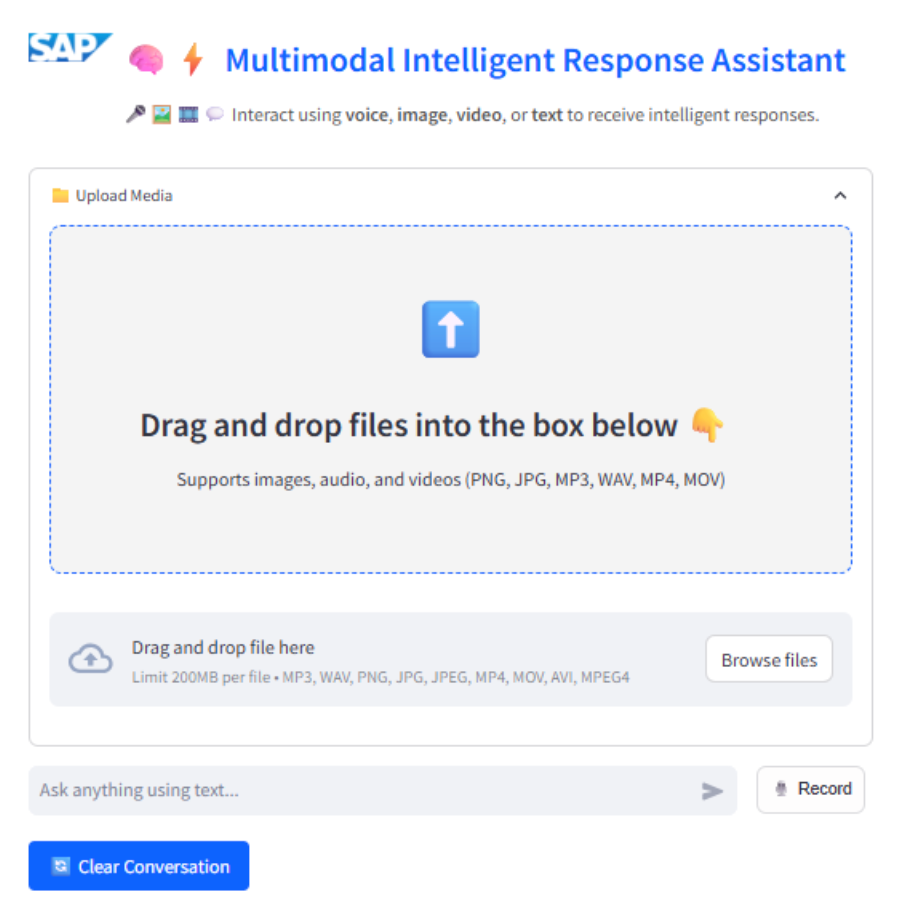
Image
Clone the project from the repository:
git clone https://github.com/SAP-samples/aicore-genai-samples.git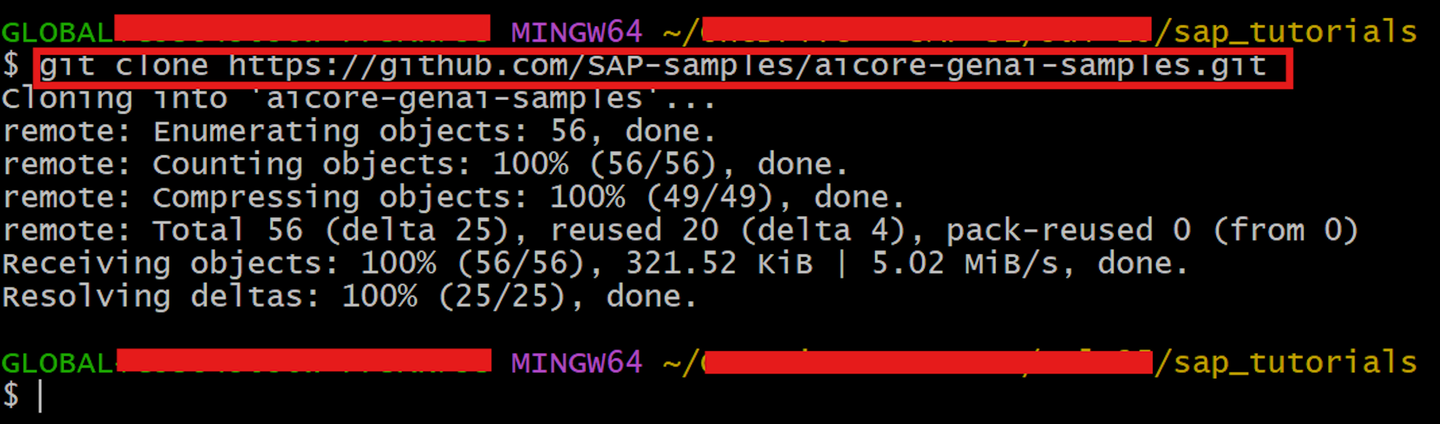
📦 Install Requirements
In VS Code, open the cloned folder and install dependencies:
pip install -r requirements.txtDeployment Steps
To deploy Gemini 2.0 Flash, follow the steps from the official SAP tutorial:
Follow Step 3 and Step 4 from this guide: Create Deployment for a Generative AI Model
To get the latest model name and version information, refer to this SAP Note: 3437766 - Generative AI Hub Models
Once deployed, note down the following:
- Model Name (e.g., gemini-2.0-flash)
- Deployment ID
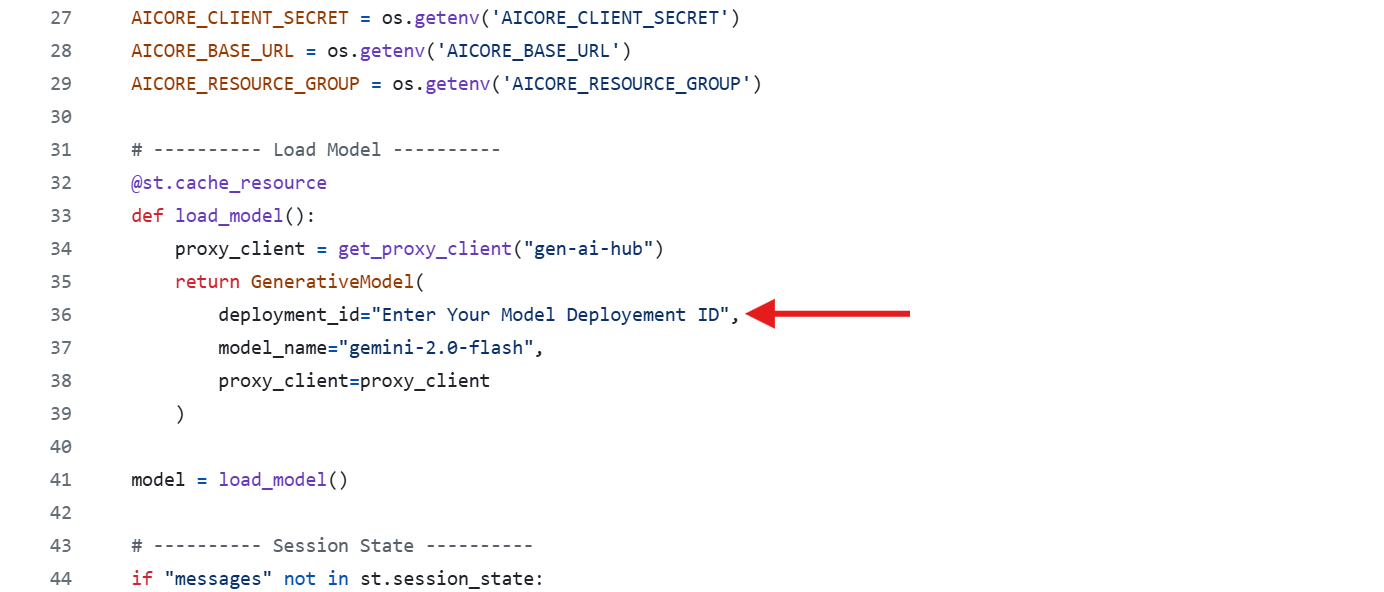
- Open main.py and navigate to the configuration section. Replace the placeholders for model name and deployment ID with your actual values:
Add Your Credentials
In the project root, create a .env file:
AICORE_AUTH_URL="your-authentication-url"
AICORE_CLIENT_ID="your-client-id"
AICORE_CLIENT_SECRET="your-client-secret"
AICORE_BASE_URL="your-base-api-url"
AICORE_RESOURCE_GROUP="your-resource-group"
Note: Make sure to use the same SAP AI Core instance and resource group where you deployed the model. This ensures the application launches and connects successfully.
Launch the App
In VS Code, open the terminal and run the below command:
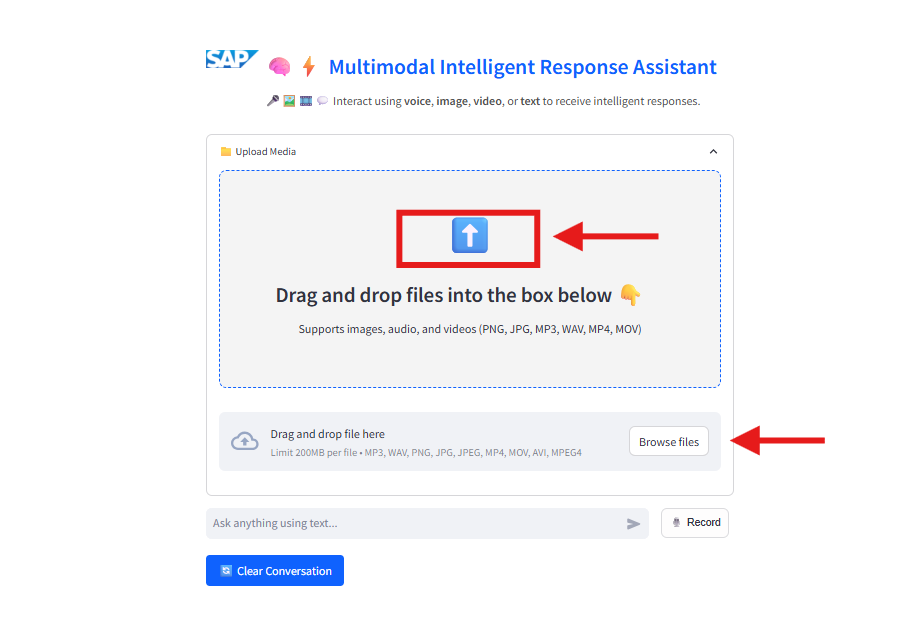
streamlit run main.py

➕ Upload Video
- Choose a short video file in formats: MP4 or MOV
- After uploading, you can ask questions such as:
- “Please provide a concise summary of the events taking place in this video”
📊 Output Observation

➕ Upload or Record Audio
- Use an audio file in formats: WAV or MP3, or record live.
- Analyze transcription or tone
- You can ask questions like:
- “What was said?”
- “Detect the language.”
📊 Output Observation

Upload an image in formats like JPG or PNG for analysis.
➕ Upload Image
- Drag & drop or select an image file
- Ask questions like:
- “Describe what is happening in this image and indentify any notabl branding or sponsorships visible.”
Output Observation

Summary
The assistant delivers accurate, context-aware responses across media types. It’s an enterprise-ready, scalable solution leveraging SAP’s AI infrastructure.
Real-world Use Cases
| Scenario | Value Proposition |
|---|---|
| 🎓 Education | AI tutors analyzing diagrams and lecture recordings |
| 🛠️ Tech Support | Use screenshots, logs, and voice memos for intelligent resolution |
| 📈 Business Insights | Analyze media submissions for trends and decisions |
| 🎤 Voice Assistants | Voice queries in workflows, meeting minutes, etc. |
Demo Video
Watch the walkthrough:
- You can find the demo video of the application here.
Image
Final Thoughts: This project demonstrates how multimodal AI can significantly enhance user interactions. By allowing inputs via text, audio, image, and video, and delivering intelligent, contextual responses, the assistant offers a flexible, enterprise-ready solution. It integrates seamlessly with SAP’s AI infrastructure and Google’s powerful models, enabling:
> Smarter user interfaces

> Scalable support systems

> Rich media understanding
Whether for education, support, or analytics, this assistant provides a practical gateway into the future of digital enterprise interaction.
Resources
Discussion
Share feedback on this tutorial or join the conversation in SAP Community.